
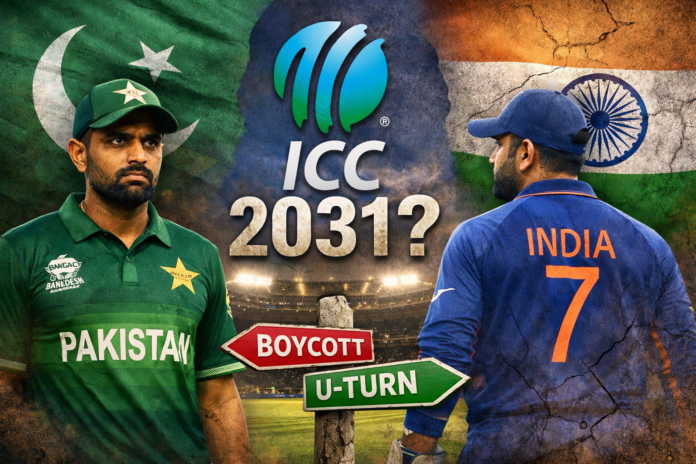
In a significant development that could reshape the future of international cricket governance, Pakistan and Bangladesh have jointly urged the International Cricket Council (ICC) to consider extending the controversial “hybrid model” for global tournaments until 2031. The move comes amid behind-the-scenes negotiations over a potential softening of India’s long-standing boycott stance toward bilateral and tournament matches hosted in Pakistan.
Background: The Hybrid Model Explained
The hybrid model was introduced as a compromise solution to address political and diplomatic tensions between certain cricket-playing nations, most notably India and Pakistan. Under this arrangement, tournaments hosted by one country are split across multiple venues, allowing teams unwilling to travel to specific nations to play their matches at neutral locations.
This model gained prominence during recent ICC events when India refused to travel to Pakistan, citing security and diplomatic concerns. As a result, matches involving India were held at alternative venues, while Pakistan retained official hosting rights. While the ICC initially positioned the hybrid model as a temporary fix, its repeated use has sparked debate about whether it is becoming a permanent feature of global cricket.
Pakistan and Bangladesh’s Strategic Push
According to sources familiar with ICC discussions, the Pakistan Cricket Board (PCB), supported by the Bangladesh Cricket Board (BCB), has proposed extending the hybrid hosting framework through 2031. Their argument centers on “predictability and stability” in tournament planning, especially for nations frequently affected by travel restrictions or political disputes.
For Pakistan, the proposal is both pragmatic and strategic. Despite significant improvements in security infrastructure and the successful hosting of international teams in recent years, Pakistan continues to face resistance from India. By securing a long-term hybrid arrangement, Pakistan aims to protect its hosting rights, commercial revenues, and global standing, even if full participation by all teams remains uncertain.
Bangladesh’s support stems from its own concerns about being caught in geopolitical crossfires. As a nation that often relies on ICC events for revenue and exposure, Bangladesh views a standardized hybrid policy as a way to prevent last-minute disruptions that could affect sponsorships, broadcasting deals, and fan engagement.
India’s Position and the “Boycott U-Turn” Talks
At the heart of the negotiations lies India’s position. The Board of Control for Cricket in India (BCCI) has consistently maintained that decisions regarding travel to Pakistan are guided by the Indian government. This stance has effectively ruled out bilateral series and direct participation in Pakistan-hosted events for over a decade.
However, recent ICC-level discussions suggest there may be subtle shifts underway. While no official confirmation has emerged, insiders indicate that India is open to exploring “flexible participation frameworks,” provided neutral venues remain an option. This has fueled speculation about a potential “boycott U-turn” — not a full reversal, but a willingness to engage under controlled conditions.
Such a shift would be significant. India is the ICC’s biggest revenue driver, and its participation heavily influences broadcasting rights, sponsorship values, and global viewership. Any compromise that keeps India engaged while accommodating other member nations is likely to be carefully considered by the ICC.
ICC’s Dilemma: Fairness vs. Financial Reality
The ICC now faces a complex balancing act. On one hand, extending the hybrid model risks criticism from member boards that view it as undermining the principle of equal hosting rights. On the other, rejecting the proposal could jeopardize major tournaments if key teams refuse to travel.
Several smaller Full Member boards have reportedly expressed mixed feelings. While some see the hybrid model as a necessary evil, others fear it could create a precedent where political influence outweighs sporting merit.
Financial considerations, however, loom large. ICC events generate billions in revenue, much of it tied to India’s participation. Ensuring uninterrupted tournaments is a top priority, especially as the ICC maps out its Future Tours Programme (FTP) beyond 2027.
What an Extension to 2031 Could Mean
If approved, a hybrid model extension until 2031 would bring long-term clarity to hosting arrangements for ICC events, including World Cups and Champions Trophy editions. It would allow host nations to plan infrastructure, logistics, and marketing campaigns well in advance, even if matches are split across borders.
For fans, the impact would be mixed. While global tournaments would continue without disruption, the hope of seeing marquee clashes played entirely in host nations could remain elusive.
The Road Ahead
As ICC meetings continue, the hybrid model debate is expected to intensify. Pakistan and Bangladesh’s push highlights growing acceptance that political realities cannot be ignored in modern cricket. Whether the ICC formalizes this approach until 2031 or seeks an alternative solution will shape the sport’s global landscape for the next decade.
For now, the hybrid model remains both a lifeline and a lightning rod — a symbol of cricket’s struggle to balance diplomacy, commerce, and the spirit of the game.