

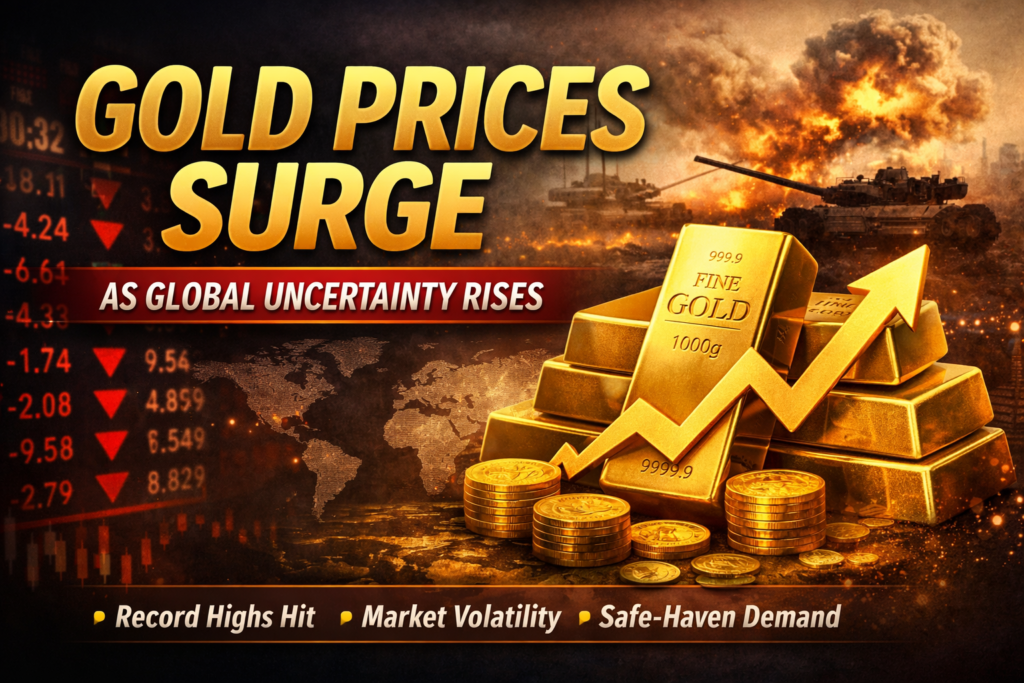
Gold prices held firm, despite intraday volatility. Global economic uncertainty and geopolitical conflicts continued to drive demand for safe-haven assets. Domestic and international bullion market activity was heightened, reflecting an investor interest that is cautious but persistent in the yellow metal.
Gold prices on the international gold market remained high, and were hovering around the $4,800 to $5,000 per ounce price range. Recent sessions have seen wide price swings as traders react globally to risk factors such as slowing economic growth, currency fluctuations and ongoing geopolitical events. While profit-taking led to occasional pullbacks in gold prices, market participants noted that overall sentiment is still supportive.
The Domestic Gold Price Recovers After Recent Drop
Gold prices in India have recovered strongly after falling earlier this week. Gold futures on the Multi Commodity Exchange have rebounded strongly, with 24-carat trading at around Rs1,59700 per 10 grams. Prices on major physical markets remained stable, supported by jewellers’ restocking and long-term investors’ renewed purchases.
Silver prices continued to fluctuate more than gold. Silver, after a sharp correction, attempted to rebound, increasing the overall volatility of the bullion market. Analysts claim that silver’s exaggerated movement in price has made gold more attractive to risk-averse investors.
The factors that support gold prices
Experts in the market attribute the stability of gold prices to both global and domestic factors.
- Growing geopolitical risk: the expiration of important global security agreements, and ongoing conflicts in other countries have increased demand for safe-havens.
- Central bank accumulation. Central banks, especially in emerging markets continue to increase their gold reserves as a hedge for currency and financial stability.
- Concerns about inflation and debt: The persistent concerns over the global debt level and inflationary pressures has reinforced gold’s appeal to investors as a store value.
- Shift in Asian Demand: Although China’s gold consumption overall has decreased for the second consecutive year, investment demand has remained high in bars and coin, partly offsetting lower jewellery sales.
Outlook: Bullish Bias, Short-Term Caution
Analysts remain positive about the medium- and long-term prospects of gold despite ongoing volatility. Many global financial institutions revised upward their gold price predictions for 2026 citing the continued uncertainty on global markets as well as expectations of accommodative policies.
Experts warn that the price swings will likely remain large in the short term. Gold is experiencing unusually high levels of volatility. Investors should be ready for unexpected corrections, even though the overall trend is positive.
Investor Strategy
Financial advisors suggest a measured approach. Investors who are looking to invest for the long-term should view gold more as a hedge than a trading tool. Short-term traders are advised to manage their risk due to the rapid price changes.
Gold is expected to be a major focus for investors over the next few weeks as global markets closely track economic data releases, signals from central banks, and geopolitical events.
India – MCX & Local Dynamics
- On MCX (5 February 2026)
- Gold (April contract: Rs1,50736 per 10g (down by 1.5%).
- Silver (March futures): Rs2,42,000 per kg (|10%).
- Gold (April contract: Rs1,50736 per 10g (down by 1.5%).
- Price trend for 10 days (Indian gold)
| Date | 24K Gold (Rs/g). | Changes to the Law of Attraction | 22K Gold (Rs/g). | Changes to the Law and Procedure |
| February 5, 2026 | Rs15,442 | -502 | Rs14,155 | -460 |
| February 4, 2026 | Rs15,944 | +551 | Rs14,615 | +505 |
| 02/03/2026 | Rs15,393 | +76 | Rs14,110 | +70 |
| Feb 02, 2026 | Rs15,317 | -741 | Rs14,040 | -680 |
| February 01, 2026 | Rs16,058 | – | Rs14,720 | – |
| Jan 31, 2026 | Rs16,058 | -862 | Rs14,720 | -790 |
| Jan 30, 2026 | Rs16,920 | -965 | Rs15,510 | -885 |
| Jan 29, 2026 | Rs17,885 | +1,177 | Rs16,395 | +1,080 |