INTRODUCTION
We’re living in an age where everything is fast and immediate. With just a few taps on your phone, you expect hot, fresh food to show up at your doorstep in no time. But unlike ordering clothes or books online, food delivery works differently; it involves real kitchens, real chefs, traffic, weather, and a lot of moving parts.
Over the past few years, food delivery has grown massively. Whether it’s a quick lunch during work, a cozy dinner with family, or planned meal kits for the weekend, millions of people now depend on fresh food delivery every day. And with that, one common question always comes up: how long will it actually take?
Delivery time is more important than it may seem. It’s not just about hunger, it’s about:
- Getting food while it’s still fresh and tasty
- Planning your time better at home or work
- Avoiding long, unexpected waiting times
Because honestly, waiting 90 minutes when you were told 30 can be really frustrating.
In this guide, we’ll break it all down in a simple way, how long fresh food delivery usually takes, what factors can delay or speed it up, and some easy tips to get your food faster.
WHAT IS FRESH FOOD DELIVERY?
Fresh food delivery simply means meals that are cooked after you place your order and then delivered straight to your home. Unlike ready-to-eat or packaged foods that are made in advance and stored on shelves, fresh food is prepared in real time in a restaurant, cloud kitchen, or even a home kitchen.
Because everything is made after you order, it feels more like a “made just for you” experience.
Types of Fresh Food Delivery
1. Restaurant Meals
This is the most common type. You order from a local restaurant using an app, the kitchen prepares your food fresh, and a delivery partner brings it to your doorstep.
2. Home-Style Cooked Food
This category is growing fast, especially in India. Local home cooks prepare daily meals, often traditional, regional, or dhaba-style food, and deliver them through apps or direct orders. It feels more homemade and comforting.
3. Meal Kits
Meal kits are a bit different. They send you fresh, pre-measured ingredients along with simple recipe steps. The ingredients are fresh, but you cook the final meal yourself at home.
Fresh Food vs Ready-to-Eat Food
It’s important not to confuse the two:
- Ready-to-eat food is already cooked, packaged, and ready to consume anytime (like instant meals or vacuum-sealed dishes).
- Fresh food delivery is cooked after you order, which means preparation time is part of the delivery process.
That’s why fresh food usually takes longer, but it often feels more freshly made and personalized.
In short, fresh food delivery is all about real-time cooking, real ingredients, and real kitchens, and that’s exactly what makes it different from everything else.
AVERAGE DELIVERY TIME FOR FRESH FOOD
So what’s the real delivery time for fresh food? Let’s break it down simply and clearly.
Standard Delivery Time
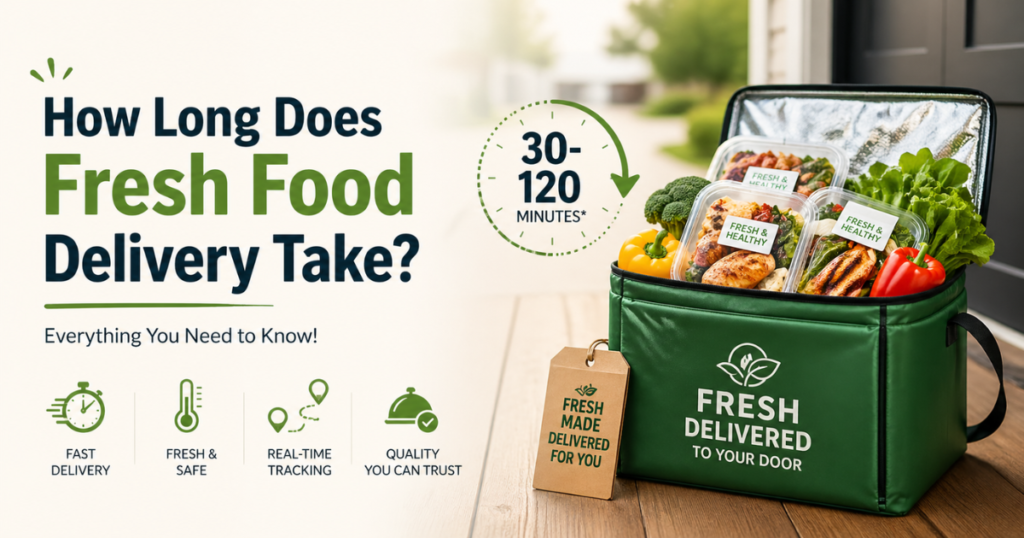
In most cities, fresh food delivery usually takes 20 to 60 minutes from the moment you place your order.
Here’s how that time is split:
- 10–25 minutes → Food preparation time in the kitchen
- Remaining time → Pickup + travel by the delivery partner
A simple order like a sandwich, burger, or rice bowl from a nearby restaurant can arrive in 20–30 minutes on a normal day.
More detailed or multi-item meals may take around 45–60 minutes.
Most apps like Zomato, Swiggy, Uber Eats, and DoorDash show an estimated delivery time before you place the order, but remember, it’s an estimate, not a guarantee.
Peak Hours Delay
Timing can change everything.
During busy hours like:
- Lunch: 12:30 PM – 2:00 PM
- Dinner: 7:30 PM – 9:30 PM
Delivery times often increase because:
- Restaurants get flooded with orders
- Kitchens take longer to prepare food
- Delivery partners are in high demand
In these cases, a normal 30-minute delivery can easily turn into 60–90 minutes or more.
Weekends and festivals? Expect even longer waiting times.
Location-Based Delivery Time
Where you live also makes a big difference.
Metro Cities
In cities like Mumbai, Delhi, Bengaluru, Hyderabad, or Chennai, delivery is usually fast, around 15 to 45 minutes.
This is because there are more restaurants and more delivery partners available nearby.
Tier-2 & Smaller Cities
In smaller cities and towns, delivery typically takes 40 to 90 minutes. Fewer restaurants and longer distances naturally increase wait time.
Remote Areas
In rural or remote locations, fresh food delivery may be limited or not available on demand at all.
Bottom Line
Fresh food delivery is usually quick, but it’s not instant. Your wait time depends on order type, time of day, and location.
If you want faster delivery, the trick is simple: order off-peak, keep it simple, and choose nearby restaurants.
FACTORS THAT AFFECT DELIVERY TIME
Understanding why your food delivery takes a certain amount of time actually makes the whole experience less frustrating. A lot of small factors come together behind the scenes to decide how fast your order reaches you.
Restaurant Preparation Time
Every dish has its own cooking time. A simple grilled sandwich might be ready in 8–10 minutes, while a slow-cooked biryani or multi-item meal can take 20–30 minutes or more. Bigger or customized orders naturally take longer because the kitchen prepares everything fresh after you order.
Distance to Your Location
Distance matters a lot. The farther you are from the restaurant, the longer the delivery takes. That’s why apps usually try to match you with nearby places within a few kilometers to keep food hot and delivery fast. Ordering from across the city? Expect extra time.
Traffic Conditions
This is one of the biggest wildcards. In busy cities, a short 3 km ride can take 10 minutes… or 35 minutes during rush hour. Delivery partners constantly adjust routes, but traffic is still something no one can fully control.
Weather Conditions
Rain can slow everything down. During heavy showers or monsoon season, roads get crowded or slippery, delivery partners drive more carefully, and demand increases because more people order in. As a result, wait times become longer.
Order Volume (Peak Hours)
During lunch and dinner rush hours, thousands of orders come in at the same time. Kitchens get busy, and delivery partners are stretched across multiple orders. Even a well-run system can slow down when demand suddenly spikes.
Delivery Partner Availability
Sometimes your food is ready, but a delivery partner isn’t immediately available nearby. That small gap between “food ready” and “pickup” can quietly add 5–15 extra minutes to your delivery time.
Simple Takeaway
Fresh food delivery is a teamwork process, itchen, traffic, weather, and delivery partners all play a role. That’s why timing can change from day to day.
Once you understand these factors, those delivery estimates start to make a lot more sense and feel a lot less random.
FRESH FOOD DELIVERY VS OTHER FOOD TYPES
Not all food deliveries work the same way. All types have unique speed, freshness, and purpose. Here’s a simple comparison to help you understand how they differ:
Fresh Food Delivery
This is the classic “order and eat” experience. The food is cooked after you place your order, which adds some preparation time, but you get a hot, freshly made meal.
- Takes: ~20–60 minutes
- Freshness: High (best when eaten immediately)
- Best for: Lunch, dinner, quick cravings
It’s faster than cooking at home, but slightly slower than ready-made food
Packaged Food Delivery
This includes items like chips, biscuits, instant noodles, or ready-to-eat pouches. These are pre-made and stored, so they don’t need cooking.
- Takes: ~10–20 minutes (in cities)
- Freshness: Medium (depends on storage, not freshly cooked)
- Best for: Snacks, quick hunger fixes, pantry stocking
Faster than fresh meals, but not the same as a properly cooked dish.
Meal Kits
Meal kits are a different experience altogether. They come with pre-portioned ingredients and recipes, but you cook the meal yourself.
- Takes: Usually 24–48 hours delivery time
- Freshness: Very high (fresh ingredients)
- Best for: Home cooking experience, learning recipes
Not instant, but great if you enjoy cooking fresh meals at home.
Quick Comparison
- Fastest: Packaged food
- Best balance (speed + freshness): Fresh food delivery
- Most planned: Meal kits
If you need food right now, fresh food delivery is the best overall choice. It gives you a good balance of speed, taste, and freshness better than packaged snacks and far more convenient than cooking from scratch or waiting for meal kits.
FASTEST FOOD DELIVERY OPTIONS
If your main goal is getting food as quickly as possible, then choosing the right type of restaurant or service makes a big difference.
Quick Service Restaurants (QSRs)
Brands like McDonald’s, KFC, and Domino’s Pizza are built for speed.
- Simple, standardized menus
- Pre-prepped ingredients
- Highly efficient kitchens
This is why they often deliver faster than regular restaurants.
Cloud Kitchens
Cloud kitchens are made only for delivery, no dine-in, no distractions.
- Focused only on online orders
- Faster kitchen operations
- Multiple brands can run from one location
This setup often leads to quicker delivery times.
10–30 Minute Delivery Services
In big cities, some platforms offer ultra-fast delivery from nearby kitchens or hubs.
For example, services like Swiggy Bolt (in selected areas) focus on delivering limited menus in record time.
Ideal when you need food urgently.
Priority Delivery Option
Most apps now offer an express or priority delivery feature (sometimes at an extra cost).
- Faster order processing
- Quicker rider assignment
- Reduced waiting time overall
A helpful option when you’re in a hurry.
Quick Summary
- Fastest overall: QSRs like McDonald’s, KFC, Domino’s
- Most optimized: Cloud kitchens
- Ultra-fast trend: 10–30 minute delivery services
- Handy shortcut: Priority delivery feature
If speed is your priority, the type of restaurant and delivery option you choose matters a lot. The simpler and closer the setup, the faster your food arrives, sometimes in just 20–30 minutes.
TIPS TO GET FASTER DELIVERY
You actually have more control over how fast your food arrives than you might think. A few simple habits can noticeably cut down your waiting time.
Order During Off-Peak Hours
This is one of the most effective tricks.
Try ordering:
- Around 11:30 AM instead of 1:00 PM
- Around 6:30 PM instead of 8:00 PM
During off-peak hours, kitchens are less busy, and delivery partners are more available, so your food moves much faster.
Pick Nearby Restaurants
It may be tempting to order from your favorite spot across town, but distance matters a lot.
- 2–3 km away = usually fast delivery
- 6–8 km away = often much slower
Closer restaurants almost always mean quicker food.
Use Express Delivery (If Available)
Many apps offer faster delivery for a small extra fee.
It prioritizes your order and assigns a nearby delivery partner sooner useful when you’re in a hurry.
Keep Your Order Simple
Customizations slow things down.
- Fewer changes = faster cooking
- Standard orders move more quickly in the kitchen
Simple orders are usually prepared and packed faster.
Pay Online
Online payment helps avoid small delays at the doorstep.
No cash handling = smoother and quicker delivery completion.
Enter a Clear Address
A surprising number of delays happen because drivers can’t find the exact location.
Add:
- Flat number
- Building name
- Nearby landmark
A clear address can easily save 5–10 minutes.
Quick Takeaway
Small choices make a big difference. If you order smart at the right time, from nearby places, and with simple instructions, you can easily enjoy faster, smoother food delivery every time.
COMMON REASONS FOR DELAY
Even if nothing goes wrong on your end, delays can occur. Here are the most common culprits:
Heavy Traffic: Especially in dense urban areas during rush hours. Not much you can do except order earlier.
Rain or Bad Weather: Delivery slows across the board during rain. Partners drive cautiously, roads get congested, and demand increases all at once.
High Order Demand: Festival evenings, match nights, or any event that keeps large numbers of people at home simultaneously creates delivery bottlenecks.
Restaurant Backlog: A popular restaurant during peak hours may have 30 orders ahead of yours in the kitchen queue. The app’s estimated time may not fully account for this.
Incorrect Address or Location Issues: If the delivery partner can’t find you, they’ll call. If there’s no answer, the order may be delayed or returned. Always keep your phone accessible when waiting for a delivery.
App or System Errors: Occasionally, technical glitches on the platform side cause assignment delays where the system takes longer than usual to match your order with a delivery partner.
FAQs
There are a few common reasons your order might be delayed, such as peak-hour rush, longer restaurant preparation time, heavy traffic, or bad weather. You can always check the live tracking feature in your app for real-time updates. If the delay keeps increasing, most apps also let you contact the delivery partner or support team directly for help.
It depends on what you’re making. For simple meals, cooking at home might take a similar amount of time. But for more complex dishes like biryani, curries, or multi-step recipes, fresh food delivery is usually much faster than preparing everything from scratch.
In well-connected metro cities, if you order from nearby cloud kitchens or quick-service restaurants, food can arrive in as little as 10 to 15 minutes. Some platforms even offer ultra-fast delivery options for select menus and areas.
Most food delivery apps provide estimated delivery times, not fixed guarantees. However, some platforms may offer credits, refunds, or compensation if the delivery goes beyond a certain delay threshold, but this depends on their policy and your location.
Almost all major apps like Zomato, Swiggy, Uber Eats, and DoorDash offer live tracking once your order is confirmed. You can see the delivery partner’s location on a map, get live status updates, and even contact them through the app if needed.