New Delhi, February 1, 2026:
The Union Budget 2026-27, presented by Finance Minister Nirmala Sitharaman, outlines the government’s roadmap for sustaining economic growth, strengthening infrastructure, promoting self-reliance, and maintaining fiscal discipline. The budget reflects a long-term development vision while addressing immediate economic priorities such as investment, employment generation, and industrial expansion.
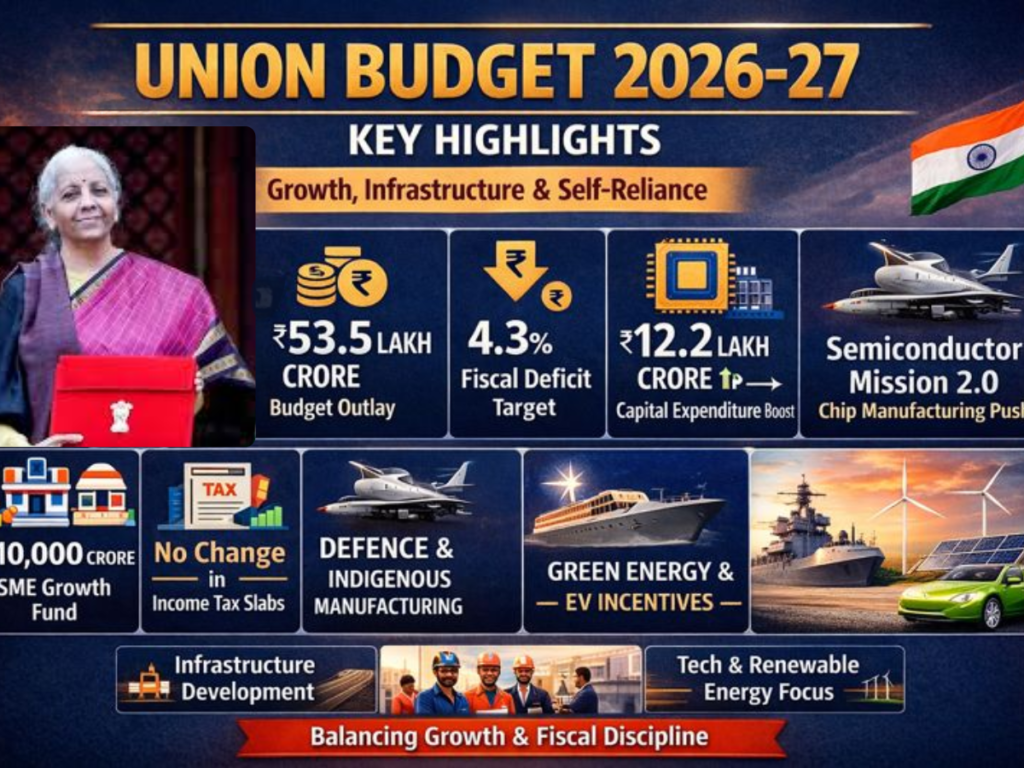
With a total outlay of around ₹53.5 lakh crore, the Union Budget 2026-27 continues to focus on capital expenditure, manufacturing growth, and technology-driven development, positioning India as a resilient and competitive global economy.
Economic Outlook and Fiscal Discipline
One of the key highlights of the Union Budget 2026-27 is the government’s commitment to fiscal consolidation. The fiscal deficit for FY 2026-27 has been targeted at 4.3% of GDP, indicating a gradual and balanced reduction in borrowing while ensuring adequate spending for growth.
The government remains optimistic about India’s economic performance, supported by strong domestic demand, rising investments, and stable macroeconomic indicators. This approach aims to strengthen investor confidence and ensure long-term economic stability.
Massive Push for Infrastructure Development
Infrastructure continues to be the backbone of India’s growth strategy. The government has allocated ₹12.2 lakh crore for capital expenditure, marking a significant increase compared to previous years.
Key infrastructure announcements include:
- Development of new high-speed rail corridors
- Expansion of national highways and expressways
- Strengthening of inland waterways and port connectivity
- Introduction of an Infrastructure Risk Guarantee Fund to encourage private sector participation
These initiatives are expected to generate employment, boost logistics efficiency, and promote regional development, especially in Tier-2 and Tier-3 cities.
Manufacturing, Technology, and Make in India
The Union Budget 2026-27 reinforces the “Make in India” and “Atmanirbhar Bharat” initiatives by focusing on advanced manufacturing and technology sectors.
Major announcements include:
- Semiconductor Mission 2.0 to strengthen India’s chip manufacturing ecosystem
- Enhanced incentives for electronics and component manufacturing
- Development of rare-earth mineral corridors to reduce import dependence
- Support for biopharma, chemicals, and capital goods manufacturing
In the technology space, the budget emphasizes artificial intelligence, cloud services, data centres, and digital infrastructure, positioning India as a global technology hub.
Support for MSMEs and Startups
Micro, Small, and Medium Enterprises (MSMEs) received special attention in the Union Budget 2026-27. To improve access to finance and support business expansion, the government announced a ₹10,000 crore SME Growth Fund.
Additional measures include:
- Strengthening credit guarantee schemes
- Mandatory use of TReDS platforms by CPSEs to improve MSME liquidity
- Simplified compliance processes for small businesses
These steps are expected to enhance cash flow, encourage formalization, and create new employment opportunities.
Taxation and Compliance Reforms
For individual taxpayers, the budget announced no changes in income tax slabs, maintaining the status quo. However, the government focused on simplifying tax compliance and reducing procedural burdens.
Key tax-related announcements include:
- Extended timelines for filing and revising tax returns
- Reduction in TCS under the Liberalised Remittance Scheme
- Customs duty rationalization on select essential and industrial inputs
- Confirmation of the rollout of the new Income Tax Act from April 1, 2026
These reforms aim to make the tax system more transparent, efficient, and taxpayer-friendly.
Defence, Green Energy, and Other Key Sectors
Defence allocation saw an increase with a strong focus on indigenous manufacturing of aircraft, engines, and naval equipment. This move supports national security while boosting domestic defence industries.
The budget also promotes:
- Renewable energy and electric mobility
- Incentives for solar, battery storage, and EV components
- Support for education, skill development, and creative industries
Conclusion
The Union Budget 2026-27 presents a balanced approach focused on growth, infrastructure expansion, manufacturing self-reliance, and fiscal responsibility. With strong capital investment, technology-driven reforms, and targeted support for businesses, the budget aims to accelerate India’s journey toward becoming a developed economy in the coming decades.